
Defects removed, never masked.
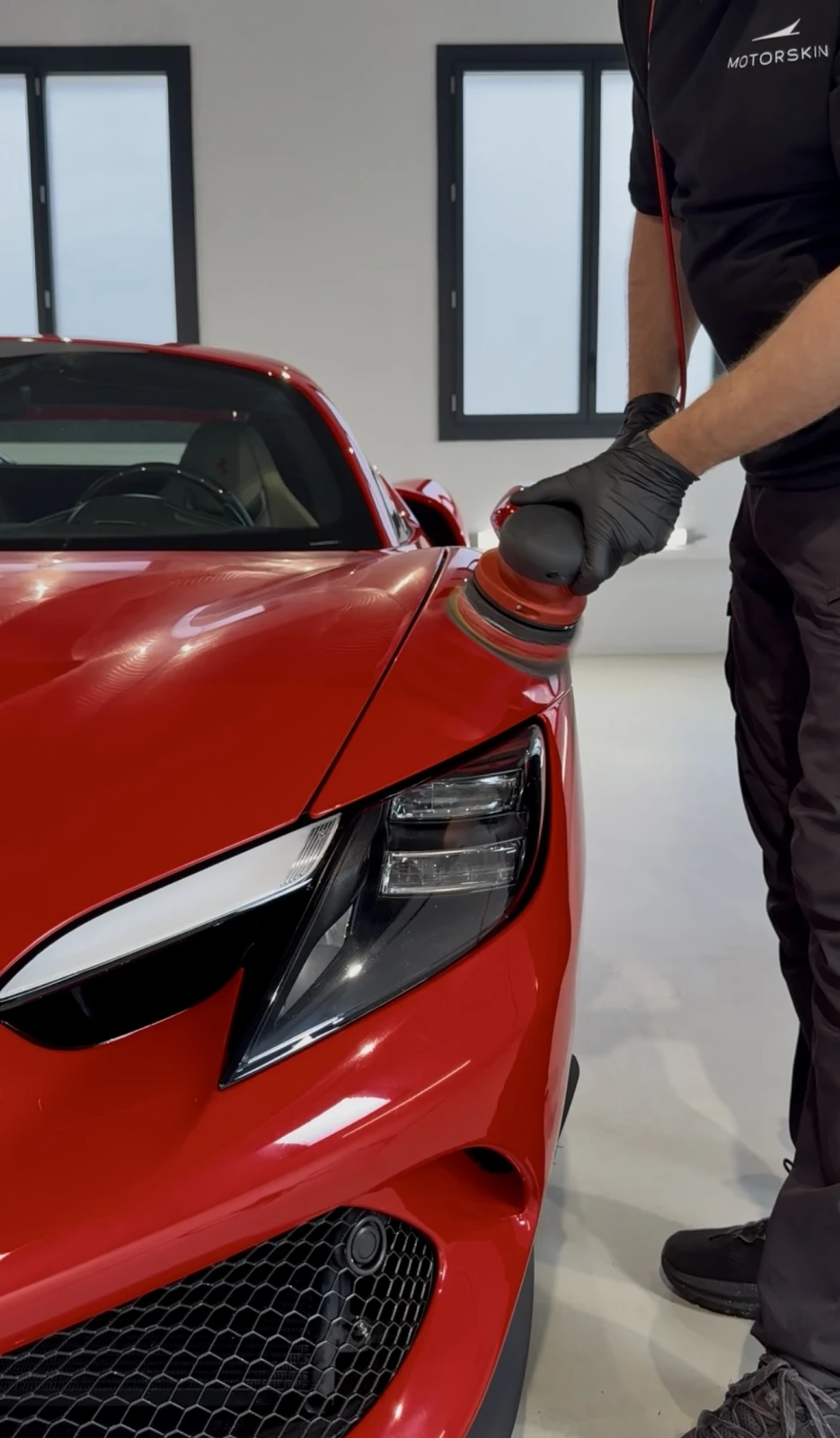
Correction is not polish in the retail sense. It is controlled removal — levelling the clear coat by fractions of a micron until swirls, scratches and haze no longer exist, instead of hiding them under fillers that wash away by the third rinse.
Every panel is read with a paint-depth gauge before a pad touches it. What we remove is decided by the numbers — so the finish is flawless and the clear coat keeps its strength for years ahead.
Swirls, haze and holograms gone. Reflections read as one clean, unbroken line.
A wet, liquid gloss the factory never quite achieved — colour with real depth beneath it.
Depth readings before and after every stage. Nothing is ever removed blind.
Defects are removed, not filled. What you see under our lights is what stays.
Choose the finish.
Every tier begins with full decontamination and a paint-depth reading, and ends under the same studio light. The difference is stages — how far the finish is taken.
Yes — when it is measured. We read every panel with a paint-depth gauge before and during the work, removing fractions of a micron only where the numbers allow. The risk comes from polishing blind; we never do.
A few microns at most — a small fraction of the factory clear coat. The gauge tells us exactly how much headroom each panel has, and every stage is planned around preserving it. We remove the defect, not the protection.
A full correction should be a rare event, not a routine. Protected by a coating and washed properly, the finish should not need it again for years. The depth readings we keep on file tell us exactly what headroom remains for the future.
Always. A coating locks in whatever lies beneath it, so any swirl or hologram would be sealed in for years. Correction gives the coating a flawless base — the depth you admire afterwards comes from this work as much as the ceramic.
What it takes to make paint
read as one reflection.
Everything we believe about machine polishing, paint measurement and the pursuit of a flawless finish — the long version, for the people who actually read it.

 01
Nice · Côte d'Azur
01
Nice · Côte d'Azur
Correction begins with a gauge, not a machine.
Before a pad touches the car, we map it. A paint-depth gauge reads every panel in microns and reveals its history — factory paint, a respray, a previous polish. Those numbers decide everything that follows: which panels can take a full correction, and which ask for a lighter hand.
It is slower this way, and that is the point. Measured removal keeps the clear coat strong for decades — and gives you a written record of exactly what was done.
One stage, two, or three.
A single-stage polish deepens gloss and clears light wash marks in a day. Two stages add a cutting pass that levels swirls and holograms before the finish is refined. Three stages are for paint that needs everything — heavier defects, oxidation, or a concours brief where good enough does not exist.
We recommend the stage after measuring, never before. The paint tells us what it needs; we simply refuse to guess.
Polished is not the same as corrected.
Much of what is sold as polishing is filling: glazes and silicone-rich waxes that sit in the scratch and hide it until the third wash. True paint correction levels the clear coat itself, so the defect is physically gone — under sun, under LED, under the harshest light a concours judge can find.
The same discipline applies to our own work. Every stage is inspected under multiple light sources before the next begins, because a hologram left by a rushed pass is a defect we would have created ourselves.
The foundation for everything else.
Correction is where every serious protection project starts. A ceramic coating or protection film locks in whatever lies beneath it, so the finish must be flawless before either is considered. In our sealed atelier in Nice, one car holds the bay at a time — corrected, inspected and photographed by the same craftsman throughout.
Whether the car goes on to ceramic, film or simply back on the road, it leaves with its depth readings on file and a finish that reads as one reflection. Done once. Done right.